

The United Nations recognises safe and healthy working conditions as a human right.1 Given the considerable risks associated with respirable crystalline silica (RCS), including lung cancer, it is vital that Australians are protected from exposure.
Crystalline Silica Substances (CSS)
Crystalline silica is a naturally occurring mineral in rocks and soils and is found in a variety of common materials including engineered stone, porcelain and ceramic products, sandstone, asphalt, and cement. These materials are referred to as crystalline silica substances (CSS).
In situ, CSS do not pose a health risk. However, when CSS are processed through activities such as cutting, grinding, and drilling, they generate airborne silica dust that can be breathed in - respirable crystalline silica (RCS).2 When inhaled by workers, this dust creates the risk of silica-related diseases.
Engineered stone
Engineered stone, also known as artificial, manufactured, or reconstituted stone, is a manufactured composite stone material that can contain very high levels of crystalline silica and resins. Prior to its ban in Australia in 2024, it was commonly used for kitchen and bathroom benchtops to replicate natural stone,3 and the proportion of silica content can vary greatly. Whilst natural stone products such as granite contain up to 45% silica, engineered stone products can contain up to 95%.3 As a result, working with engineered stone is much more likely to expose workers to very high levels of RCS compared to other CSS. The introduction of high silica content engineered stone resulted in an alarming increase in silicosis incidence amongst Australian workers.4 Between 2015 and 2022, 482 silicosis workers’ compensation claims were received in Victoria, a 27-fold increase from the previous 8-year period.4 Of the 210 claims received in Victoria between 2019 and 2022, 95% of the affected workers worked with engineered stone in the countertop industry.4 Queensland and Victorian data indicated that one in four workers exposed to RCS from engineered stone before 2018 have been diagnosed with silicosis.5 In response to this, in 2024 the Australian Government implemented a ban on the use, supply and manufacture of engineered stone, and strong restrictions on the processing of CSS.6 For more information, see Policy context and impact.
Whilst this ban was vital for the protection of individuals who work with engineered stone, many industries that use other forms of CSS remain at risk of harmful exposure, and therefore rigorous prevention and controls remain essential.
Occupational exposure
Occupations that are most exposed to RCS include miners, construction workers, farmers, and engineers.7 It is estimated that over 500,000 Australians are currently exposed to RCS at work.8 Reducing occupational exposure is essential to reducing the burden of silica-related disease, such as lung cancer, on Australian workers.
Workplace Health and Safety Laws
Workplace health and safety (WHS) laws help to maintain a safe working environment. WHS laws are regulated and enforced by the Commonwealth, state, and territory governments. For more information, see Policy context and impact.
Workplace exposure standard
Currently the workplace exposure standard for RCS in Australia is 0.05 mg/m³, a time-weighted average (TWA) airborne concentration over 8 hours.2 However, research has identified 0.02 mg/m³ as the level at which the risk of lung cancer would be reduced to an acceptably low level.9, 10 Whilst not enforced, this level is still recommended by some WHS regulators.11 Given the evidence, Australian workers are considered at an unacceptably high increased risk of developing lung cancer with the current WES for RCS of 0.05 mg/m³. Whilst changing the WES for silica to 0.02 mg/m³ will improve protection and reduce the risk for Australian workers, there is no evidence that identifies a safe level of RCS exposure and as such exposure must still be limited as much as reasonably practicable.
Control Measures
Under the model WHS laws, businesses are required to identify high risk CSS use and implement control measures to eliminate or reduce a worker’s RCS exposure as much as reasonably practical.2 Control methods should be highly effective when implemented appropriately. In a working population of 18.7 million Australians, using wet cutting methods during concrete cutting and grinding was estimated to potentially prevent 6% of the lung cancer cases caused over their lifetime due to their occupational exposure to RCS.8 In line with WHS laws, employers should eliminate or reduce exposure to hazards by following the hierarchy of controls risk management process (Figure 1).
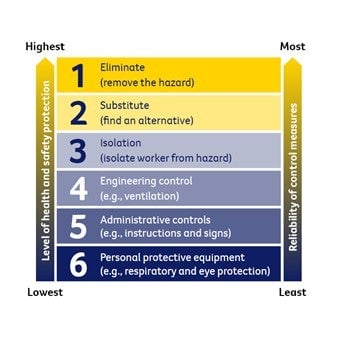
Figure 1.: The hierarchy of controls
Where elimination of RCS cannot occur, to effectively control or eliminate the generation of RCS in the workplace a combination of different measures must be implemented. These measures include:2
- Substituting CSS with products that do not contain crystalline silica or contain lower levels of crystalline silica.
- Isolating the hazard – using principles of safe work design to designate areas for tasks that generate dust and appropriate worker positioning during these tasks.
- Incorporating engineering controls that minimise the risk of exposure to generated dust, for example effective water delivery system, local exhaust ventilation or using tools with dust collection attachments.
- Applying administrative controls, such as written policies and procedures for processing CSS, equipment maintenance logs and signage.
- Personal protective equipment. This involves each person who is at risk from working with CSS:
- (i) is provided with effective respiratory protective equipment and trained in its use; and
- (ii) wearing the respiratory protective equipment while the work is carried out.
Health Surveillance
Silica-related diseases can develop years after exposure to RCS.12 Therefore, regular health surveillance (or monitoring) is critical for workers who are at increased risk of silica-related disease. Health surveillance is a requirement under WHS regulations for workplaces where workers have a risk of RCS exposure.2 Health surveillance includes assessing a worker's health before they begin working with RCS, ensuring that any changes to their health can be closely tracked over time.2 Whilst there is national guidance for doctors assessing workers exposed to respirable crystalline silica dust,13 the specific requirements for surveillance are not nationally consistent.2 The Silica National Strategic Plan 2024–30 and National Dust Disease Taskforce final report call for the development of a National Early Detection and Rapid Response Protocol to improve the identification of emerging workplace risk, utilising data from a range of sources, including the National Occupational Respiratory Disease Registry.5, 14
Whilst routine lung screening and surveillance has the potential to improve early diagnosis, further evidence into effective routine screening methods is needed.14, 15 For silica-exposed workers, evidence indicates low-dose high-resolution CT scans are more effective than chest X-rays in detecting early lung changes, such as silicosis.16, 17 Currently, all states and territories besides Western Australia require X-rays for respiratory health surveillance, rather than low-dose high-resolution CT scans.2 Nationally consistent workplace health surveillance programs, guided by a robust evidence-base, have the potential to improve the quality, consistency, and coverage of health surveillance for workers at risk of RCS exposure.
Education and Awareness
The lack of understanding and awareness among both businesses and workers of the risks associated with CSS and RCS exposure is a significant barrier to preventing silica-related diseases.5 WHS regulations require those working with high-risk CSS to undertake nationally-accredited training, or training approved by the WHS regulator, on the health risks associated with RCS exposure, and the control measures required by WHS laws.2 Effective workplace education on the risks of RCS, the importance of control interventions and the need for respiratory protective equipment (RPE) has the potential to significantly reduce exposure.9 Education and awareness are a key policy priority in Australia’s Silica National Strategic Plan 2024–30.14 Ongoing investment in national prevention, awareness and education strategies related to silica is essential to reducing Australian workers’ exposure and preventing silica-related diseases.
- UN General Assembly. International Covenant on Economic, Social and Cultural Rights: United Nations; 1966.
- Safe Work Australia. Working with crystalline silica substances. 2024.
- Health and Safety Executive (UK). ST0 – Advice for managers. COSHH essentials for stone workers: Silica United Kingdon: Health and Safety Executive; 2019 [cited 2025 Feb 18]. Available from: https://www.hse.gov.uk/pubns/guidance/st0.pdf.
- Hoy RF, Tomic D, Gwini S, Dimitriadis C, Abramson M, Collie A, et al. The Rapid Rise of Silicosis in Victoria, Australia Associated With Artificial Stone Countertop Industry Work. Am J Ind Med. 2025.
- National Dust Disease Taskforce, Department of Health. National Dust Disease Taskforce – Final report. 2021.
- The Department of Employment and Workplace Relations. Prohibition on the use of engineered stone 2024 [cited 3 Feb 2025]. Available from: https://www.dewr.gov.au/engineeredstone.
- Carey RN, Driscoll TR, Peters S, Glass DC, Reid A, Benke G, et al. Estimated prevalence of exposure to occupational carcinogens in Australia (2011-2012). Occup Environ Med. 2014;71(1):55–62.
- Carey R, Fritschi L. The future burden of lung cancer and silicosis from occupational silica exposure in Australia: A preliminary analysis. Curtin University of Technology; 2022.
- Anlimah F, Gopaldasani V, MacPhail C, Davies B. A systematic review of the effectiveness of dust control measures adopted to reduce workplace exposure. Environ Sci Pollut Res Int. 2023;30(19):54407–28.
- Safe Work Australia. WES review 2018 : WES Methodology : recommending health-based workplace exposure standards and notations. Canberra, ACT: Safe Work Australia; 2018.
- Work Safe Victoria. Construction: Preventing exposure to crystalline silica dust 2024 [cited 10 Feb 2025]. Available from: https://www.worksafe.vic.gov.au/preventing-exposure-crystalline-silica-dust.
- Howlett P, Gan J, Lesosky M, Feary J. Relationship between cumulative silica exposure and silicosis: a systematic review and dose-response meta-analysis. Thorax. 2024;79(10):934–42.
- National Dust Disease Taskforce Working Group. National Guidance for doctors assessing workers exposed to respirable crystalline silica dust with specific reference to the occupational respiratory diseases associated with engineered stone. 2022.
- The Asbestos and Silica Safety and Eradication Agency Silica National Strategic Plan 2024–30. 2024.
- Austin EK, James C, Tessier J. Early Detection Methods for Silicosis in Australia and Internationally: A Review of the Literature. Int J Environ Res Public Health. 2021;18(15).
- Hoy RF, Glass DC, Dimitriadis C, Hansen J, Hore-Lacy F, Sim MR. Identification of early-stage silicosis through health screening of stone benchtop industry workers in Victoria, Australia. Occup Environ Med. 2021;78(4):296–302.
- Hoy RF, Jones C, Newbigin K, Abramson MJ, Barnes H, Dimitriadis C, et al. Chest x-ray has low sensitivity to detect silicosis in artificial stone benchtop industry workers. Respirology. 2024;29(9):785–94.