

Breast cancer
About breast cancer
The different types of breast cancer, how it develops, and who can be affected including the role of genetics and family history.


Last updated:
Sources and references 
What is breast cancer?
Breast cancer is the abnormal growth of cells in the breast. It usually starts in the lining of the breast ducts or lobules, and can grow into cancerous (malignant) tumours. Most breast cancers are found when they are invasive. This means that the cancer has spread from the breast ducts or lobules into the surrounding breast tissue. Invasive breast cancer can be early, locally advanced or advanced (metastatic). Advanced breast cancer is when cancer cells have spread (metastasised) outside the breast and nearby lymph nodes to other parts of the body. About 5% of cancers are advanced when breast cancer is first diagnosed.
Breast cancer in men is uncommon; transwomen or non-binary people can also get breast cancer.
The breasts
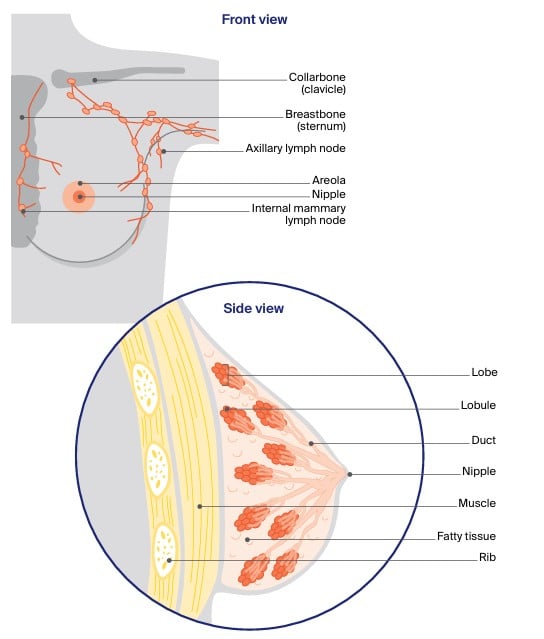
The breasts sit on top of the upper ribs and a large chest muscle. They cover the area from the collarbone (clavicle) to the armpit (axilla) and across to the breastbone (sternum). Some breast tissue extends into the armpit and is called the axillary tail.
Female breasts are mostly made up of:
- lobes – each breast has 12–20 sections called lobes
- lobules – each lobe contains glands that can produce milk; these milk glands are called lobules or glandular tissue
- ducts – the lobes and lobules are connected by fine tubes called ducts; the ducts carry milk to the nipples when breastfeeding
- fatty/fibrous tissue – all breasts contain some fatty or fibrous tissue (including connective tissue called stroma), no matter their size.
Most younger women have dense or thicker breasts because they contain more lobules than fat. Male breasts have ducts and fatty/fibrous tissue. They usually contain no, or only a few, lobes and lobules.
The lymphatic system – The lymphatic system is an important part of the immune system, which protects against disease and infection. The lymphatic system drains excess fluid from body tissues into the blood. It is made up of a network of thin tubes called lymph vessels. These vessels connect to groups of small, bean-shaped lymph nodes (or glands). There are lymph nodes throughout the body, including in the armpits, neck, abdomen, groin and chest (near the breastbone). The first place breast cancer cells usually spread to is the lymph nodes in the armpits (axillary lymph nodes) or to the lymph nodes near the breastbone (internal mammary lymph nodes).
How common is breast cancer?
It is estimated that 20,336 people were diagnosed with breast cancer in 2025. The average age at diagnosis is 62 years old.
Women – In Australia, breast cancer is the most common cancer in women (apart from common skin cancers), with 1 in 8 women diagnosed by age 85. Young women can get breast cancer, but it is more common over the age of 40, and the risk increases with age. In rare cases, pregnant or breastfeeding women can get breast cancer. See a doctor about any persistent lump noticed during pregnancy.
Men – About 220 men (most aged over 60) are diagnosed with breast cancer each year. It is treated in the same way as for women. For more information, visit Cancer Australia, or Breast Cancer Network Australia.
Transgender, non-binary and gender-diverse – Any transgender woman taking medicines to boost female hormones and lower male hormones has a higher breast cancer risk (compared with a man). A transgender man who has had breasts removed in a nipple-sparing mastectomy can still get breast cancer, although the risk is low.
Does breast cancer run in families?
Most people with breast cancer do not have a strong family history, but a small number may have inherited a gene fault (also called a mutation) that increases their breast cancer risk.
BRCA1 and BRCA2 – These are the most common gene mutations linked to breast cancer. Women in families with BRCA1 or BRCA2 are at increased risk of breast and ovarian cancers. Men in families with BRCA2 may be at increased risk of breast and prostate cancers.
Other genes linked to breast cancer – These include ATM, BARD1, CDH1, CHEK2, PALB2, PTEN, RAD51C, RAD51D, and TP53. More gene mutations linked to breast cancer are being found all the time. A genetic test called an extended gene panel test checks for the most common types of genes linked with breast cancer. To find out if you have inherited a gene mutation, talk to your doctor or breast cancer nurse about visiting a family cancer clinic or genetic oncologist. Your specialist may also be able to order genetic tests. In particular, women diagnosed before 40 years, those with triple negative breast cancer diagnosed before 60 years, and men with breast cancer should ask for a referral. Genetic testing is covered by Medicare for some, but not all, people; ask your doctor about this.
What are the different types of breast conditions and breast cancers?
Non-invasive breast conditions
These are conditions where the abnormal cells have not invaded nearby tissues. Also called carcinoma in situ.
Ductal carcinoma in situ (DCIS)
- abnormal cells in the breast ducts
- may develop into invasive breast cancer
- treatment is similar to that for invasive breast cancer, but chemotherapy is not used
Lobular carcinoma in situ (LCIS)
- abnormal cells in the breast lobules
- does not develop into cancer but increases the risk of developing cancer, including in the other breast
- usually treated with surgery, and hormone therapy may be used
- more regular mammograms or other scans needed to check for any changes
Invasive breast cancers
Invasive means that the cancer cells have grown and spread beyond the breast ducts/lobules and into the surrounding tissue. The 2 main types of invasive breast cancer are named after the breast area that they start in.
Invasive ductal carcinoma (IDC)
- starts in the breast ducts
- about 80% of breast cancers are IDC
Invasive lobular carcinoma (ILC)
- starts in the breast lobules
- about 10% of breast cancers are ILC
Less common breast cancers include inflammatory breast cancer, medullary carcinoma, mucinous carcinoma, Paget disease of the nipple (or breast) and papillary carcinoma. Phyllodes tumour is a rare breast condition that may be benign or malignant.
If invasive breast cancer spreads beyond the breast tissue and the nearby lymph nodes, it is called advanced or metastatic breast cancer. Find out about treatment for advanced breast cancer, or visit bcna.org.au or canceraustralia.gov.au.
Sources and references
This information has been developed by Cancer Council NSW on behalf of all other state and territory Cancer Councils and Cancer Council Australia as part of a National Cancer Information Subcommittee initiative. We thank the reviewers of this content: Dr Diana Adams, Medical Oncologist, Macarthur Cancer Therapy Centre, NSW; Prof Bruce Mann, Specialist Breast Surgeon and Director, Breast Cancer Services, The Royal Melbourne and The Royal Women’s Hospitals, VIC; Dr Shagun Aggarwal, Specialist Plastic and Reconstructive Surgeon, Prince of Wales, Sydney Children’s and Royal Hospital for Women, NSW; Andrea Concannon, consumer; Jenny Gilchrist, Nurse Practitioner Breast Oncology, Macquarie University Hospital, NSW; Monica Graham, 13 11 20 Consultant, Cancer Council WA; Natasha Keir, Nurse Practitioner Breast Oncology, GenesisCare, QLD; Dr Bronwyn Kennedy, Breast Physician, Chris O’Brien Lifehouse and Westmead Breast Cancer Institute, NSW; Lisa Montgomery, consumer; A/Prof Sanjay Warrier, Specialist Breast Surgeon, Chris O’Brien Lifehouse, NSW; Dr Janice Yeh, Radiation Oncologist, Peter MacCallum Cancer Centre, VIC. We also thank the health professionals, consumers and editorial teams who have worked on previous editions of this title.
Photographs have been reproduced with permission from A/Prof James French, Westmead Breast Cancer Institute, NSW; Prof Elisabeth Elder, Westmead Breast Cancer Institute and The University of Sydney, NSW; and Breast Cancer: Taking Control, breastcancertakingcontrol.com © Boycare Publishing, 2010.

Breast Cancer
Cancer Council 13 11 20
Call us to talk to a specially trained health professional for free and confidential support and information.
Guide to best cancer care
This breast cancer guide explains the standard of high-quality cancer care that all Australians can expect, from diagnosis, to treatment, recovery, and living with cancer.