


What is benzene?
Benzene is a colourless, flammable liquid found in a range of materials and products like crude oil, petroleum, and in laboratories. It can also be used as a solvent in manufacturing, paints, varnishes, lacquer thinners, and as a degreasing agent. Benzene evaporates from these substances into a vapour that can be inhaled but can also be absorbed in its liquid form into the skin. Benzene is also released during fires, from burning fuels, and through tobacco smoking1 or e-cigarette vaping.2
Benzene and cancer
Repeated or long-term exposure to benzene increases the risk of myelodysplastic syndrome (MDS) and leukaemia (and possibly lymphoma) by damaging a person’s stem cells.3-5 Not everyone exposed to benzene will develop cancer, but the risk increases if a person is regularly exposed to benzene.
Exposure to higher levels of benzene can also increase the risk of chronic conditions like anaemia, while short-term exposure can cause eye, skin, and lung irritation, and poisoning at high concentrations.1
Exposure to benzene at work
In Australia, it is estimated that 31% of workers (or about 4.6 million workers) are exposed to benzene while working, with 3.6% having high levels of exposure.6 Benzene exposure most commonly occurs by breathing in benzene vapours in the air. However, workers can also be exposed through contact with the skin.7 People may be exposed to benzene both during and outside of work, with vehicle exhaust and cigarette smoke and e-cigarette aerosols being the most common sources of exposure .1,2 Jobs and industries where workers might be at risk of exposure to benzene include:3,7
- Oil, gas, and coal production
- Chemical manufacturing
- Plastics and rubber manufacturing
- Transport, storage and tanker workers
- Working at service stations
- Mechanics and automotive workers
- Laboratory workers
- Firefighting
Benzene is a restricted carcinogen under Australian work health and safety (WHS) laws. This means that workplaces using or storing benzene require authorisation from their state or territory WHS regulator.
Effective controls
All workplaces operating in Australia must follow WHS laws. While these laws vary slightly between states and territories, the duty of care for employers and responsibilities of workers is similar throughout Australia:
- Employers are required to ensure the health and safety of workers and others at their workplace.
- Workers must take reasonable care of their own health and safety.
- Workers must not negatively affect the health and safety of other people.
- Workers must follow workplace health and safety policies and any reasonable instruction.
- Workers should always be involved in the risk management process, including the identification of hazards and the selection of control measures that suit the workplace.
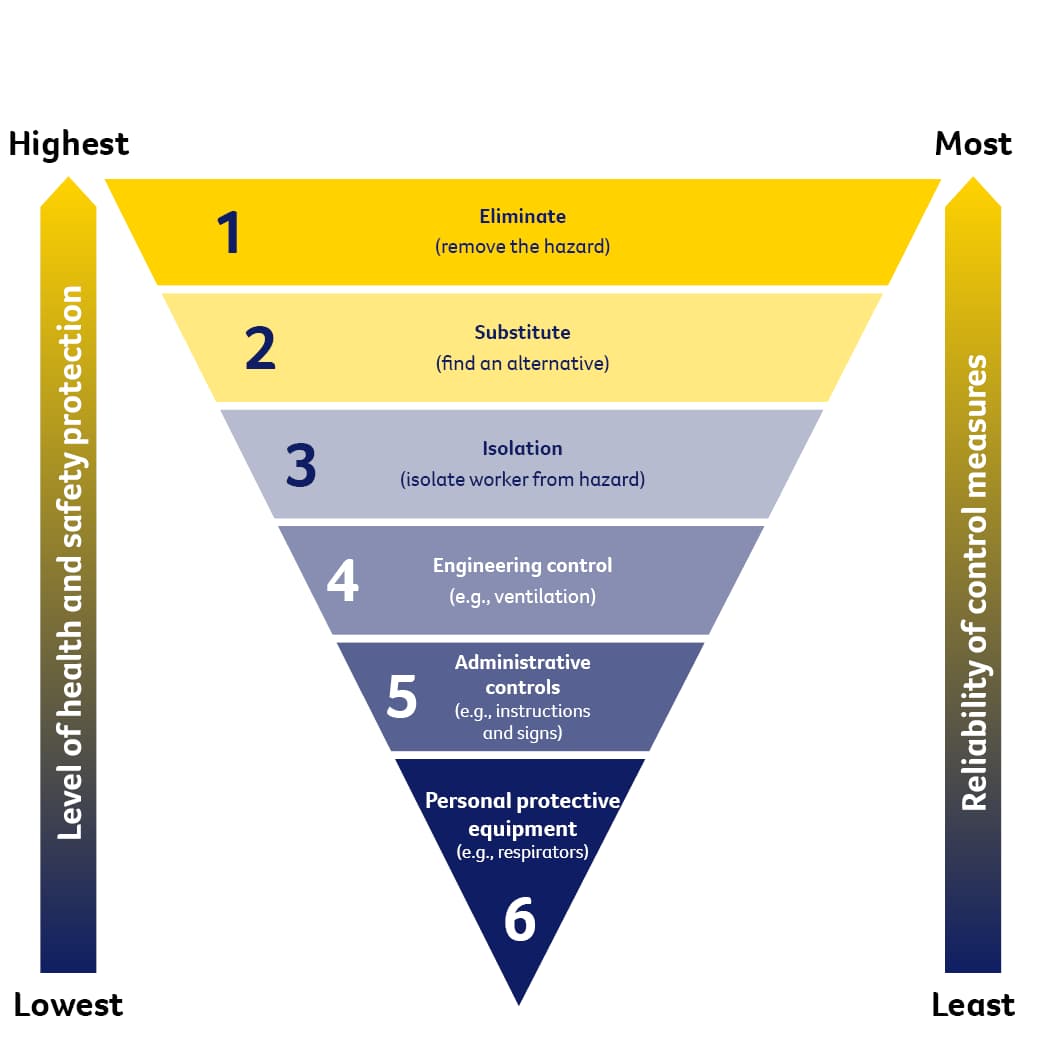
The risk of exposure to benzene in the workplace can be managed using the hierarchy of control (Figure 2), which provides a framework for eliminating or reducing benzene exposure. Involving workers in the risk assessment and risk management process helps ensure that all risks have been identified and that controls are appropriate for the job.
If suitable control measures are not in place, anyone working with or around benzene has an increased risk of exposure and therefore an increased risk of developing associated health effects or disease (e.g. leukaemia). A summary of recommended controls is outlined in Table 1.
Figure 1. Hierarchy of control
Air monitoring for benzene
Regulations require air monitoring to be carried out to determine levels of benzene in the air and ensure that controls are effective. This should be performed by a competent and accredited person, like an occupational hygienist.
The exposure limit set by Safe Work Australia requires workplace benzene exposure to be kept below 1 ppm (or 3.2 mg/m3), averaged over an eight-hour period. However, the American Conference of Governmental Industrial Hygienists (ACGIH) have recommended this be limited to 0.02 ppm (0.64 mg/m3). Even if exposure levels are being met, employers should aim to reduce exposure to as low as reasonably practicable.
Health Monitoring
Under WHS regulations, health monitoring must be arranged for those who may be exposed to harmful levels of benzene at work. Health monitoring aims to detect high levels of benzene metabolites (chemicals produced when the body breaks down benzene) before irreversible changes like cancer occur. Workers should undertake health monitoring before, during, and after terminating high-risk benzene work. Safe Work Australia’s Health Monitoring Guide for Benzene outlines the process of conducting health monitoring.
Table 1. Summary of control measures for benzene
ACTIVITY | CONTROL |
Elimination | Where practicable, eliminate the use of benzene. |
Product/material choice | Replace petrol engines with other energy sources (e.g., electric). If the use of a benzene fuel source or engine is necessary, opt for those with low emissions (e.g., using a biogas or a hybrid vehicle). Refer to Material Safety Data Sheets to determine the concentration of benzene in a particular solvent or chemical. |
Engine refurbishment | Install devices that reduce emissions, such as a catalytic converter. |
Ventilation | Use local exhaust ventilation (LEV) to remove benzene vapours from the source at which they are produced. Use vapour recovery when filling tankers with petroleum. |
Worker education and training | Train and educate workers on the risks of benzene exposure and the controls that reduce these risks. This may occur through e-Learning, presentations/toolbox talks, workshops, and demonstrations of how to correctly use controls. Workers should also be made aware of the need to report incidents or conditions that may increase exposure (e.g., changes in engine emissions or a chemical spill). |
Share activities | Rotate jobs between your workers to reduce the amount of time each worker is exposed to benzene. |
Administrative | Display signs warning workers of the risks of benzene and the need to use controls. Implement policies preventing unnecessary benzene exposure (e.g., those requiring engines to be turned off when not in use). Ensure materials containing benzene are labelled appropriately and stored as per the Safety Data Sheet. |
Personal protective equipment (PPE) | Wear an air supplied or air-purifying respirator to prevent inhalation of benzene vapours. When handling benzene, use PPE like chemical-resistant gloves to prevent contact with the skin. |
Quit smoking/vaping | The benzene present in cigarettes can result in people who smoke being exposed to ten times as much benzene as those who do not smoke.7 Benzene can also be found in e-cigarette aerosol.8 Quitting or cutting down on smoking and vaping reduces the amount of benzene you are exposed to both during and outside of work.1,2 |
How do I detect cancer early and reduce my occupational cancer risk?
The best way to reduce your cancer risk is to limit your exposure to known carcinogens. It’s important you speak with your doctor if you are concerned about your exposure to benzene or have been experiencing symptoms like:
- Tiredness
- Shortness of breath
- Recurring infections
- Increased bruising and bleeding
- Tiredness
- Shortness of breath
- Recurring infections
- Increased bruising and bleeding
To find out what you can do to create a workplace that supports healthy choices and helps reduce cancer risk, contact Cancer Council 13 11 20.
Where can I get reliable information?
Other useful websites
- US Department of Health & Human Services. Facts about Benzene. Centers for Disease Control and Prevention; 2018. Available from: https://emergency.cdc.gov/agent/benzene/basics/facts.asp
- Pankow JF, Kim K, McWhirter KJ, Luo W, Escobedo JO, Strongin RM et al. Benzene formation in electronic cigarettes. PLoS One. 2017; 12(3): Article e0173055. doi: 10.1371/journal.pone.0173055.
- International Agency for Research on Cancer. IARC monographs on the evaluation of carcinogenic risks to humans. Benzene. Volume 120. Lyon, France: IARC, 2018.
- Schnatter AR, Glass DC, Tang G, Irons RD, Rushton L. Myelodysplastic syndrome and benzene exposure among petroleum workers: an international pooled analysis. J Natl Cancer Inst. 2012;104(22):1724-37. doi:10.1093/jnci/djs411
- Rana I, Dahlberg S, Steinmaus C, Zhang L. Benzene exposure and non-Hodgkin lymphoma: a systematic review and meta-analysis of human studies. Lancet Planet Health. 2021; 5(9): e633-43. doi: 10.1016/S2542-5196(21)00149-2.
- Safe Work Australia. Insights from the Australian Worker Exposure Survey 2026. Canberra: Safe Work Australia; 2026. Available from: https://data.safeworkaustralia.gov.au/reports/hazards-and-injuries/insights-australian-worker-exposure-survey-2026
- Carey RN, Driscoll TR, Peters S, Glass DC, Reid A, Benke G, Fritschi L. Estimated prevalence of exposure to occupational carcinogens in Australia (2011–2012). Occupational and Environmental Medicine. 2014;71(1):55-62. doi: 10.1136/oemed-2013-101651.
- Wallace LA. Major sources of benzene exposure. Environ Health Perspect. 1989;82:165-9. doi:10.1289/ehp.8982165
- National Health and Medical Research Council. Inhalation toxicity of non-nicotine e-cigarette constituents: risk assessments, scoping review and evidence map [Internet]. Canberra: NHMRC; 2022. Available from: https://www.cancer.nsw.gov.au/getmedia/b9634eca-cea4-46e0-9bbc-5b6755cc64a0/Scoping-review-on-the-inhalation-toxicity-of-non-nicotine-e-cigarette-constituents.pdf