

Bladder cancer
About bladder cancer
Learn about the different types of bladder cancer, including the three main types, the symptoms and risks.


Last updated:
Sources and references What's on this page

What is bladder cancer?
Bladder cancer begins when cells in the inner lining of the bladder (urothelium) become abnormal. This causes the cells to grow and divide out of control. As the cancer grows, it may start to spread into the deeper layers of the bladder wall (see diagram on previous page). Some cancer cells can also break off and travel outside the bladder to other parts of the body (e.g. lymph nodes, lungs, bones or liver).
The bladder
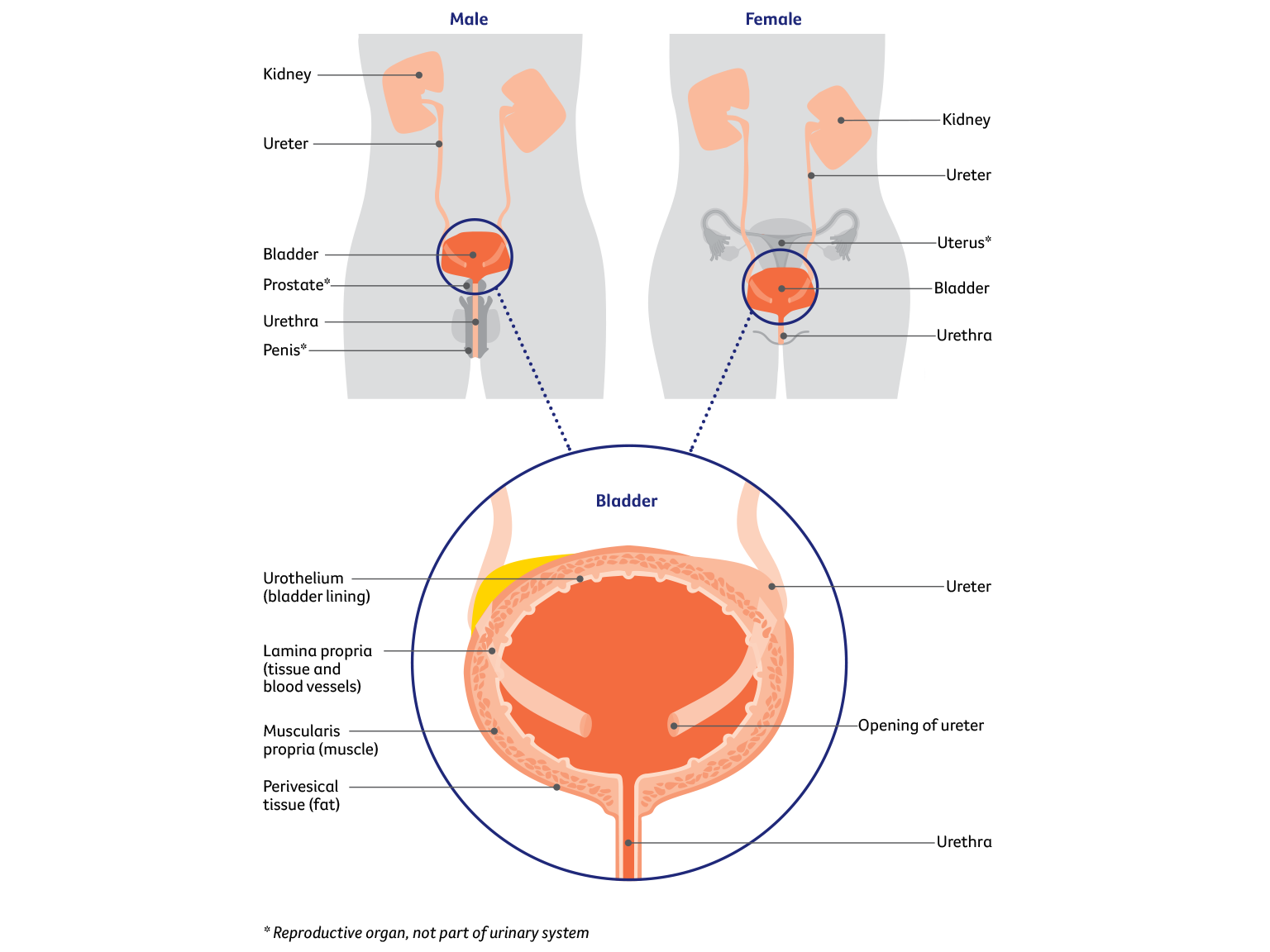
The bladder is a hollow, muscular sac that stores urine (wee or pee). It sits behind the pubic bone in the pelvis, and is part of the urinary system.
The urinary system also includes 2 kidneys, 2 tubes called ureters that lead from the kidneys into the bladder, and another tube called the urethra that leads out of the bladder. In males, the urethra is a long tube that passes through the prostate and down the penis. In females, the urethra is shorter and opens in front of the vagina (birth canal).
The kidneys produce urine, which travels to the bladder through the ureters. The bladder is like a balloon and expands as it fills with urine. A layer of muscle wraps around the urethra and works like a valve to keep the bladder closed and stop leaking of urine. When you are ready to empty your bladder, the bladder muscle tightens and the valves open, and urine passes through the urethra and out of the body.
Layers of the bladder wall
There are 4 main layers of tissue in the bladder:
Urothelium
The inner layer. It is lined with cells called urothelial cells that stop urine being absorbed into the body.
Lamina propria
The layer of tissue and blood vessels that surrounds the urothelium.
Muscularis propria
The thickest layer. It consists of muscle that tightens to empty the bladder.
Perivesical tissue
The outer layer. Mostly made up of fatty tissue, it separates the bladder from nearby organs.
The urinary system
How common is bladder cancer?
It is estimated that 3,345 people were diagnosed with bladder cancer in 2025. The average age at diagnosis is 75 years old.
Most people diagnosed with bladder cancer are aged 60 or older, but it can occur at any age. About 1 in every 67 males will be diagnosed with bladder cancer before age 85, making it 1 of the 10 most common cancers in males. For females, the risk is about 1 in 234 before age 85, although it is often diagnosed at an advanced stage.
Sources and references
Acknowledgments
This edition has been developed by Cancer Council NSW on behalf of all other state and territory Cancer Councils as part of a National Cancer Information Subcommittee initiative. We thank the reviewers of this booklet: Dr Malinda Itchins, Thoracic Medical Oncologist, Royal North Shore Hospital and Chris O’Brien Lifehouse, NSW; Dr Cynleen Kai, Radiation Oncologist, GenesisCare, VIC; Dr Naveed Alam, Thoracic Surgeon, St Vincent’s Hospital, Epworth Richmond, and Monash Medical Centre, VIC; Helen Benny, Consumer; Dr Rachael Dodd, Senior Research Fellow, The Daffodil Centre, NSW; Kim Greco, Specialist bladder Cancer Nurse Consultant, Flinders Medical Centre, SA; Caitriona Nienaber, 13 11 20 Consultant, Cancer Council WA; Marco Salvador, Consumer; Janene Shelton, bladder Foundation Australia – Specialist bladder Cancer Nurse, Darling Downs Health, QLD; Prof Emily Stone, Respiratory Physician, Department of Thoracic Medicine and bladder Transplantation, St Vincent’s Hospital Sydney, NSW; A/Prof Marianne Weber, Stream Lead, bladder Cancer Policy and Evaluation, The Daffodil Centre, NSW. We would also like to thank the health professionals, consumers and editorial teams who have worked on previous editions of this title.

Bladder cancer
Cancer Council 13 11 20
Call us to talk to a specially trained health professional for free and confidential support and information.