

Types of cancer
Managing symptoms of mesothelioma
Symptoms of mesothelioma may be managed with a combination of drug therapies and pleural drains.


Last updated:
Sources and references 
For many people, mesothelioma is diagnosed at an advanced stage, and the main aim of treatment is to manage symptoms and keep them under control for as long as possible. Treating symptoms will help improve your quality of life. Treatment may slow tumour growth, make you feel better and help you live longer. This is called palliative treatment.
Palliative treatment aims to manage the symptoms without trying to cure the disease. It can be used at any stage of advanced cancer to improve quality of life. It does not mean giving up hope – rather it is about living as fully and comfortably as possible. Early palliative care is sometimes also called supportive care.
This section describes treatments and strategies for managing some common symptoms of mesothelioma, such as fatigue, difficulty sleeping, breathlessness, pain, constipation and weight loss. As you may be experiencing several symptoms, you may have a combination of treatments. Keep in mind, however, that you won’t necessarily experience all the symptoms listed here.
If symptoms return after a period of relatively good health, you may be offered a different combination of treatments and strategies.
There are treatments, but there’s no cure. It just gives people a bit more time. At the moment I feel fine. I have my ups and downs and get tired.”
Serafina
Fatigue
It is common to feel tired during and after treatment, and to lack energy for day-to-day activities. Fatigue for people with cancer is different from tiredness, as it may not go away with rest or sleep. You may lose interest in things that you usually enjoy doing or feel unable to concentrate for very long.
If fatigue is a problem, talk to your treatment team. Sometimes fatigue can be caused by a low red blood cell count (anaemia) or the side effects of drugs, and can be treated. While you can’t always avoid fatigue, you can find ways to improve your energy levels.
Managing fatigue
- Set small, manageable goals for the day, and rest before you get too tired.
- Plan breaks throughout the day when you are completely still for a while. An eye pillow can help at these times.
- Ask for and accept offers of help with tasks such as shopping, cleaning and gardening.
- Say no to things you really don’t feel like doing.
- Leave plenty of time to get to appointments.
- Sit down whenever you can.
- Ask your doctor what sort of exercise would be suitable. Even a walk around the garden or block can boost your energy levels.
- Eat nutritious food to keep your energy levels up.
- Consider acupuncture – some people find it helps with fatigue.
Difficulty sleeping
Getting a good night’s sleep is important for maintaining your energy levels, reducing fatigue, and improving mood. Difficulty sleeping may be caused by pain, breathlessness, anxiety or depression. Some medicines can also disrupt sleep.
If you had sleep problems before the mesothelioma diagnosis, these could become worse. Talk to your doctor about what might be helpful for you. Medicines you are taking may need adjusting or you may need other drugs to help you sleep. Strategies that may be helpful in improving your sleep quality are listed below.
Getting a better night's sleep
- Try to do some gentle exercise daily. This will help you sleep better. Talk to a physiotherapist or exercise physiologist, who can tailor an exercise program, and an occupational therapist, who can suggest equipment to help you move safely. See our Exercise for People Living with Cancer booklet.
- Limit or cut out the use of alcohol, caffeine, nicotine and spicy food.
- Avoid television or using computers or smartphones before bed, as the blue light may tell your body it’s time to wake up.
- Follow a regular routine before bed and set up a calm sleeping environment. Make sure that the room is dark, quiet and a cool, comfortable temperature.
- Try soothing music, a recording of rain sounds, or a relaxation recording. Listen to our “Sleep and Cancer” podcast episode and our Finding Calm During Cancer podcast series for more tips:
Breathlessness
Shortness of breath, also called breathlessness or dyspnoea, is the most common symptom of pleural mesothelioma. This is often caused by a build-up of fluid in the pleural cavity known as pleural effusion.
The fluid can put pressure on the lung, making it harder to breathe. In the earlier stages of pleural mesothelioma, controlling this fluid build-up will improve breathlessness. The level of improvement will depend on the health of your lungs before diagnosis, and how well they function after surgery. You may also feel breathless because of the cancer itself not allowing the lung to work properly (trapped lung).
In peritoneal mesothelioma, a build-up of fluid (ascites) can cause the abdomen to swell. This can be painful, but also puts pressure on the diaphragm and can make you feel breathless.
Other problems such as infection or a low level of red blood cells (anaemia) can also cause breathlessness. Living with breathlessness can be difficult, but there are ways to reduce its impact on your life and manage it at home.
Draining fluid around the lungs
Fluid build-up around the lungs may be drained before mesothelioma is diagnosed or at the same time as a biopsy.
Ways to control fluid around the lungs
Talc pleurodesis – To prevent fluid building up again in the lining of the lungs, you may have a talc pleurodesis. Pleurodesis means closing the pleural cavity. Sterile talcum powder (talc slurry) is injected into the pleural cavity, and the talc slurry causes an inflammation that helps fuse the two layers of the pleura together and closes the space.
A talc pleurodesis is best done during VATS by a thoracic surgeon, but is sometimes done by a respiratory physician. After a talc pleurodesis, some people experience a burning pain in the chest for 24–48 hours. This pain can be eased with medicine and you will be able to have physiotherapy to improve lung expansion.
VATS with pleurectomy decortication – When fluid is drained and talc pleurodesis is done during VATS, part or all of the outer layer of the pleura (parietal pleura) is removed. This is known as pleurectomy decortication (PD). This may be done when the parietal pleura, which lines the chest wall, has become thick and stiff.
Thoracotomy with pleurectomy decortication – Even after VATS and talc pleurodesis, the fluid may build up around the lungs again, causing breathlessness. The surgeon may suggest a more extensive surgery called thoracotomy (open surgery) with pleurectomy decortication (PD). This surgery may also be recommended as a first option if the cancer has grown in a way that makes it difficult to perform VATS successfully. A thoracotomy helps to prevent fluid building up again in most cases. It also makes it easier for the lungs to expand and to transfer oxygen to the blood. Pain after having a thoracotomy can last longer than pain after having VATS, but the improvement in symptoms may make open surgery a worthwhile option if VATS has not been successful or if it isn’t possible.
Indwelling pleural catheter – Some people cannot have VATS or open surgery, either because they are too unwell or because the cancer has grown in a way that makes the surgery too difficult. Instead, you may be offered an indwelling pleural catheter (also known as a drain) to remove the fluid and improve your breathing. This can also be used if the pleural fluid builds up again after pleurodesis.
Under local anaesthetic, the specialist inserts a thin tube (the catheter) through the chest wall into the pleural cavity. You can manage the drain at home with the help of a community nurse, family member or friend. When the fluid builds up and needs to be drained (usually once or twice a week), the end of thecatheter is connected to a bottle.
With an indwelling pleural catheter, the fluid may stop building up, and the cavity may close. In these cases the drain can be removed.
Having a pleural tap
In pleural mesothelioma, a pleural tap (also known as pleurocentesis or thoracentesis) drains fluid from around the lungs.
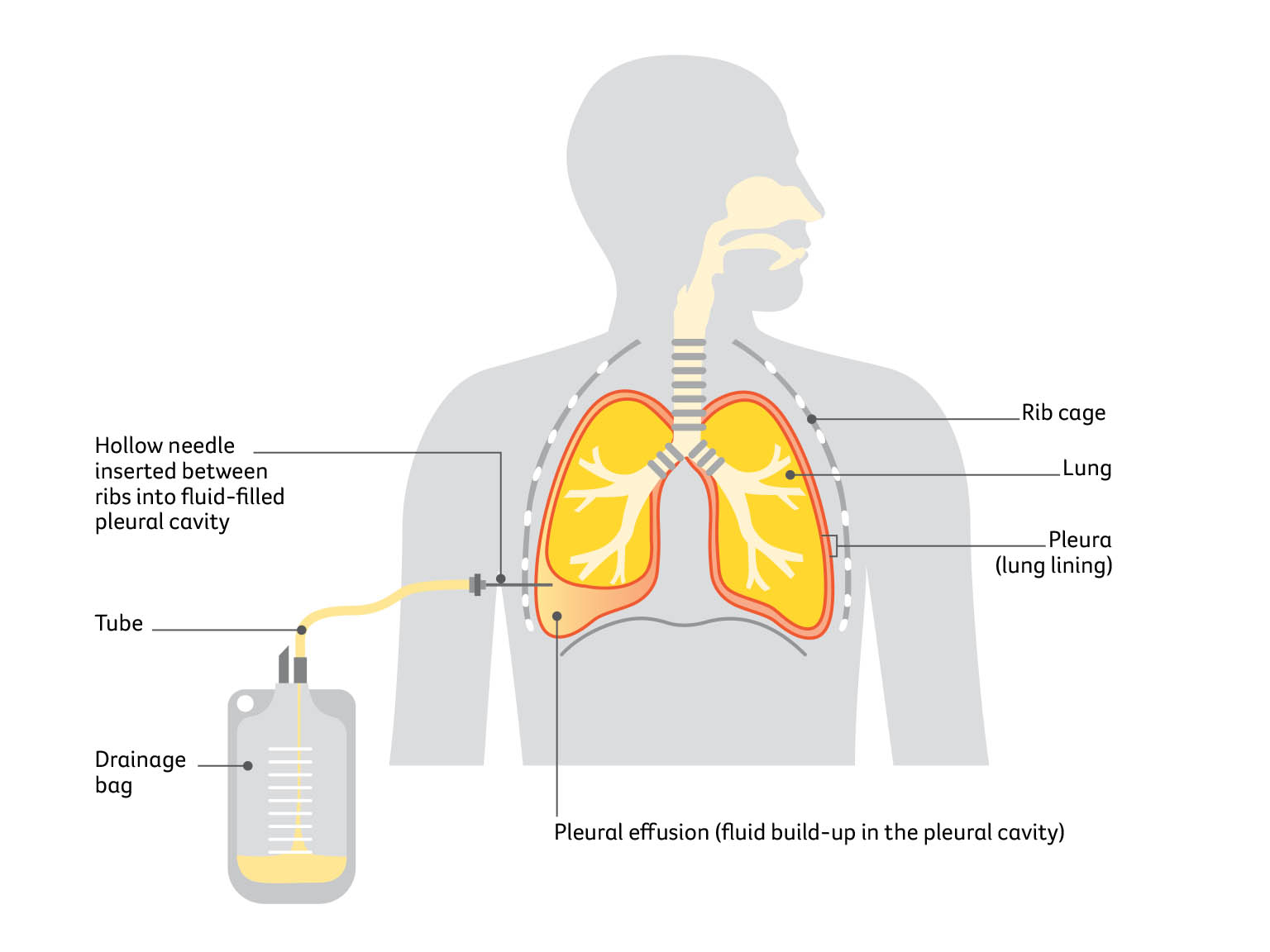
- Your doctor will numb the area with a local anaesthetic and insert a needle between your ribs into the fluid-filled pleural cavity.
- An ultrasound scan may guide the needle to the fluid. The needle is connected to a bag for the fluid to drain into.
- The process of draining the fluid usually takes anywhere between 30 and 60 minutes.
- You usually don’t have to stay overnight in hospital after having a pleural tap.
Ways to drain or control fluid in the abdomen
Peritoneal tap – In peritoneal mesothelioma, a peritoneal tap (also known as paracentesis) drains fluid from the abdomen. Your doctor will numb the area with a local anaesthetic and insert a needle through the skin into the peritoneal cavity. An ultrasound may guide the needle to the fluid. The needle is connected to a bag for the fluid to drain into over a few hours. A peritoneal tap may be done while you are still having tests. You usually don’t have to stay overnight in hospital after a peritoneal tap.
Indwelling peritoneal catheter – If fluid keeps building up around the abdomen, a small tube can be inserted to allow fluid to flow into a bottle. This is known as an indwelling peritoneal catheter or drain. Under local anaesthetic, the specialist inserts a thin tube (catheter) into the abdomen. You can manage the drain at home with the help of a community nurse, family member or friend. When the fluid builds up and needs to be drained (usually once or twice a week), the end of the catheter is connected to a bottle.
Heated chemotherapy – To help prevent fluid building up again, you may have a single dose of heated chemotherapy directly into the abdomen (HIPEC) during a laparoscopy.
Improving breathlessness at home
It can be distressing to feel short of breath, but several simple strategies can help provide some relief from breathlessness at home.
Treat other conditions
Let your doctor know if you feel breathless. Conditions such as anaemia, a lung infection or chronic obstructive pulmonary disease may also make you feel short of breath and these can often be treated.
Check if equipment could help
Ask your health care team about equipment to manage breathlessness. You may be able to use an oxygen concentrator at home to deliver oxygen to your lungs. For social outings and medical appointments, you can use a portable oxygen cylinder. If you have a cough or wheeze, you may benefit from a nebuliser, a device that delivers medicine into your lungs.
Sleep more upright
Use a recliner chair or prop yourself up in bed to help you sleep in a more upright position. An occupational therapist may be able to recommend a special pillow for sleeping.
Relax on a pillow
Rest your head and upper chest on a table with a pillow. Bend from your hips and keep your back straight. This helps to relax your breathing muscles.
Ask about medicines
Talk to your doctor about medicines, such as a low dose of morphine, to ease breathlessness. It is also important to keep any chest pain well controlled because pain may prevent you from breathing deeply.
Modify your movement
Some types of gentle exercise can help but check with your doctor first. An exercise physiologist, physiotherapist or occupational therapist from your treatment centre can explain how to modify your activities to improve breathlessness.
Create a breeze
Use a handheld fan to direct a cool stream of air across your face if you feel short of breath when not exerting yourself. You may also find it helpful to sit by an open window.
Find ways to relax
Listen to a relaxation recording or learn other ways to relax. This can help you to control anxiety and breathe more easily. Some people find breathing exercises, acupuncture and meditation helpful.
Pain
Many people are naturally worried about being in pain. It’s important to tell your treatment team if you are in pain. Pain may be a symptom of mesothelioma, but can also be a side effect of treatment.
Pain caused by mesothelioma is usually dull and generalised – it can be difficult to say exactly where it is coming from. If the cancer spreads and presses on bones or organs, it may feel sharp and stabbing. A sharp pain in the chest can also be caused by a blood clot in the lungs (pulmonary embolism), so seek urgent medical help if the pain is new. Chemotherapy or surgery can injure nerves causing pain or numbness.
There are several different ways to control pain.
Pain medicines – Different types and strengths may be used:
- mild, like paracetamol
- moderate, like codeine
- strong and opioid-based, like morphine.
Pain medicines may come as tablets, oral liquids, patches, injections or intravenous infusions. Non-steroidal anti-inflammatory drugs (NSAIDs) or drugs for nerve pain may also be prescribed. Many people need a combination of medicines for good pain control.
Opioids, such as morphine or oxycodone, are the most common drugs used for moderate-to-severe mesothelioma pain (and may be used for breathlessness). Morphine is available in quick-acting and long-acting forms. Some people worry they might get addicted to morphine. Pain specialists believe this is unlikely if you take it as prescribed to relieve acute pain or for palliative care. Morphine can
be taken for a long time and in increasing doses, if needed. It doesn’t have to be saved for when pain is very bad. There are many strong pain medicines similar to morphine, so if one doesn’t work, ask your doctor for other options. A small number of people have difficulty controlling their pain, and a pain management specialist may help find a solution.
Procedures to manage fluid build-up – Aside from breathlessness, fluid build-up around the lungs or abdomen can cause pain. Various treatments can help drain the fluid and try to prevent it building up again.
Radiation therapy – This may be used to shrink mesothelioma that is pressing on nerves, bones or major blood vessels and causing pain. Sometimes the mesothelioma can grow through the scar from VATS surgery and produce a lump in the skin. Radiation therapy can reduce the size of the lump and ease any associated pain.
Chemotherapy – This can reduce the size of the mesothelioma that is causing the pain.
Debulking surgery – If you are well enough and it is technically possible, surgery may be used to remove the part of the mesothelioma causing pain and other symptoms. This is known as debulking surgery. Talk to your doctor for more information.
I couldn’t believe how much better I felt after some pain relief. Everything seemed less stressful and I didn’t feel so angry and upset all the time.”
Bill
Ways to cope with pain at home
Keep notes on your pain
Describe and track pain in a symptom diary – what it feels like, how intense it is, exactly where it is, where it comes from and goes to, how long it lasts, and if it goes away with a medicine or a heat pack, etc.
Take it slow
Allow a few days for your body to adjust to the dose of pain medicine and for any drowsiness to improve.
Report side effects
Let your doctor know if you have vivid dreams, nausea or other side effects after taking a strong pain medicine such as morphine or oxycodone.
Watch for constipation
Ask your doctor if you need a laxative or stool softener prescribed to prevent or relieve constipation (difficulty passing bowel movements) caused by pain medicines.
Keep up your medicine
Take pain medicine regularly as prescribed, even when you’re not in pain. It’s better to stay on top of the pain.
Check your pain plan
Ask your doctor to review your pain management plan regularly. If you have problems, adjusting the dose may help, or you can try other methods of pain relief.
Constipation
Having infrequent or difficult-to-pass bowel movements (also called faeces, stools or poo) is known as constipation. Common causes include not getting enough exercise, eating too little fibre, or not drinking enough fluids. Opioid pain medicines, some anti-nausea drugs and some chemotherapy drugs may also cause constipation.
Severe constipation with abdominal pain, bloating, nausea and vomiting may be signs of a blockage in the bowel (bowel obstruction). This occasionally happens with peritoneal mesothelioma, but rarely with pleural mesothelioma. To relieve the symptoms, you may have a small tube (stent) put in to help keep the bowel open. If the bowel is completely blocked, it needs to be cleared with emergency surgery.
Managing constipation
- Drink plenty of fluids.
- Eat fresh fruit and vegetables and fibre-rich foods (e.g. prunes, apples with skin on), unless your doctor advises otherwise.
- Try to be physically active every day. Talk to your doctor or physiotherapist to find the exercise that is right for you.
- Ask your doctor how to manage constipation. You may be prescribed medicines to help stimulate bowel movements.
- Try over-the-counter laxatives such as Coloxyl with senna, Duphalac or Movicol. Check the dose with the pharmacist and let your doctor know. Don’t wait too long before starting laxatives.
- Talk to your treatment team about how to manage bowel obstruction (described above). If your stomach is swollen and you are in pain, call Triple Zero (000) as it may be an emergency.
Poor appetite and weight loss
Some people have little interest in eating and lose weight even before mesothelioma is diagnosed. These symptoms may be caused by the disease itself, or by nausea, trouble swallowing, changes in taste or smell, breathlessness, abdominal pain, or feeling down.
Eating well will help you cope better with day-to-day living, treatment and side effects, and improve your quality of life.
A palliative care specialist can help manage symptoms that affect your appetite or ability to eat. You may also find it useful to talk to a dietitian who is experienced in treating people with cancer. They can provide helpful eating suggestions.
Eating when you have little appetite
- Have small meals and snacks regularly. A large, full plate may put you off eating – try using a smaller plate with smaller portions. Likewise, drink from a half-full glass.
- Eat moist food such as scrambled eggs. Moist food tends to be easier to eat and will cause less irritation if you have a sore mouth.
- Avoid fatty or sugary foods if these make you feel sick.
- Use lemon juice and herbs to add flavour to bland foods.
- Eat more of your favourite foods – follow your cravings.
- Carry snacks so you can eat any time you feel like it. Try muesli bars, dried fruit and nuts, crackers or fruit buns.
- If solid food doesn’t appeal, ask a dietitian about protein drinks or other supplements.
Palliative treatment
The options described here are usually considered palliative treatment because their main aim is to manage symptoms rather than cure the disease. Your doctor may suggest palliative treatment for any symptoms caused by mesothelioma or refer you to a palliative care specialist.
Chemotherapy, immunotherapy, radiation therapy and surgery may be used to slow the spread of mesothelioma and control symptoms such as pain or breathlessness. Oxygen and medicines (e.g. benzodiazepines) may also be used to help control symptoms.
If you have a build-up of fluid around the lungs or abdomen, various procedures can drain the fluid and help prevent it building up again.
Palliative treatment can be used at any stage of mesothelioma to improve quality of life. In fact, palliative treatment can help some people with mesothelioma to live fulfilling lives with minimal symptoms for longer. Palliative treatment is one aspect of palliative care.
My husband did not want to accept help from the palliative care people. He said that once they got involved he would not have much longer left to live. But his GP told him about what they do and how they help with symptoms and comfort. He agreed to try and now would not be without them.”
Grace
Understanding palliative care
Many people fear hearing the words palliative care because they think it is just for people who are dying, but it’s not. Palliative care is useful at all stages. of advanced cancer and involves a range of services that can help with many things like pain management or getting around more easily.
What is palliative care?
Palliative care is person-centred care that helps people with a progressive life-limiting illness to live as fully and as comfortably as possible. Palliative care can link you with support. For example, you may need help to move around your home more safely. The main goal is to help you maintain your quality of life by identifying and meeting your physical, emotional, cultural, social and spiritual needs. It also provides support to families and carers.
Who is in a palliative care team?
Palliative care may be led by your GP or community nurse, or by the specialist palliative care team in your area. The team may include doctors, nurses, social workers, physiotherapists, occupational therapists, and spiritual care practitioners. They may also link you to a counsellor, psychologist or other health professionals.
Where is palliative care usually given?
The palliative care team will help you to work out the best place for your care. This may be in your own home supported by community palliative care services, in hospital, at a residential aged care facility or in a palliative care unit (sometimes called a hospice). Many health care services are now available to you at home.
How can palliative care help?
Palliative care involves a range of services that will be tailored to your individual needs. There are various ways it can help, including:
- relief of pain, breathlessness, nausea and other symptoms
- help organising equipment for home (e.g. wheelchairs, special beds)
- links to other services such as home help and financial support
- referrals to respite care services
- volunteer services trained in palliative care
- counselling, grief and bereavement support.
When can I start care?
Depending on your needs, you may use palliative care services occasionally or continuously, for a few weeks or months. The number of people receiving palliative care for several years is increasing. Contacting the palliative care team early means that you can find out what the different team members do and see which services might be useful now or in the future. This will vary according to how you feel, what problems you have, and how your carers are managing.
Where to find out more
For more information about what palliative care is and how it helps, visit the Palliative Care Australia website. Use the directory on this website to find a palliative care service in your local area, or speak to your doctor or nurse.
Key points about managing symptoms
Overview
Most people have treatment to control the symptoms of mesothelioma and improve their quality of life.
Breathlessness
- Breathlessness caused by fluid build-up around the lungs is the most common symptom of pleural mesothelioma. It can usually be controlled with surgery – either a type of keyhole surgery called video-assisted thoracoscopic surgery (VATS) or a type of open surgery called thoracotomy.
- Breathlessness caused by fluid build-up in the abdomen is a common symptom of peritoneal mesothelioma. It can be controlled with an indwelling peritoneal catheter or heated chemotherapy (HIPEC).
- Simple ways to improve breathlessness at home include using a fan, leaning forward on a table over a pillow or sleeping in a recliner chair.
Other symptoms
- Manage fatigue by setting small goals for the day, and resting before you get too tired.
- Strong pain is often treated with opioid-based drugs such as morphine. In some cases, chemotherapy, immunotherapy, radiation therapy or surgery can be used to manage pain.
- Try to drink plenty of fluids and eat fresh fruit and vegetables to ease constipation.
- Palliative treatment helps to improve a person’s quality of life by managing symptoms. It’s best to start palliative treatment early.
Sources and references
Understanding Mesothelioma - A guide for people with cancer, their families and friends
Acknowledgments
This edition has been developed by Cancer Council NSW on behalf of all other state and territory Cancer Councils as part of a National Cancer Information Subcommittee initiative.
All updated content has been clinically reviewed by A/Prof Anthony Linton, Medical Oncologist, Concord Cancer Centre and Concord Repatriation General Hospital, NSW; Dr Naveed Alam, Thoracic Surgeon, St Vincent’s Private Hospital Melbourne and Monash Medical Centre, VIC; Prof David Morris, Peritonectomy Surgeon, St George Hospital and UNSW, NSW.
This edition is based on the previous edition, which was reviewed by the following panel: A/Prof Anthony Linton (see above); Dr Naveed Alam, (see above); Donatella Arnoldo, Consumer; Polly Baldwin, 13 11 20 Consultant, Cancer Council SA; Dr Melvin (Wee Loong) Chin, Medical Oncologist, Sir Charles Gairdner Hospital and National Centre for Asbestos Related Diseases, WA; Prof Kwun Fong, Thoracic and Sleep Physician and Director, UQ Thoracic Research Centre, The Prince Charles Hospital, and Professor of Medicine, The University of Queensland, QLD; Vicki Hamilton OAM, Consumer and CEO, Asbestos Council of Victoria/ GARDS Inc., VIC; Dr Susan Harden, Radiation Oncologist, Peter MacCallum Cancer Centre, VIC; Penny Jacomos, Social Worker, Asbestos Diseases Society of South Australia, SA; Prof Brian Le, Director, Parkville Integrated Palliative Care Service, The Royal Melbourne Hospital and Peter MacCallum Cancer Centre, VIC; Lung Cancer Support Nurses, Lung Foundation Australia; Jocelyn McLean, Mesothelioma Support Coordinator, Asbestos Diseases Research Institute, NSW; Prof David Morris (see above); Joanne Oates, Registered Occupational Therapist, Expert Witness in Dust Diseases, and Director, Evaluate, NSW; Chris Sheppard and Adam Barlow, RMB Lawyers.
We also thank the health professionals, consumers and editorial teams who worked on previous editions of this title. Previous editions of this title and related resources were funded in part by the Heads of Asbestos Coordination Authorities and a donation from Lyall Watts.

Mesothelioma
Cancer Council 13 11 20
Call us to talk to a specially trained health professional for free and confidential support and information.
Guide to best cancer care
This mesothelioma guide explains the standard of high-quality cancer care that all Australians can expect, from diagnosis, to treatment, recovery, and living with cancer.