

Lung cancer
About lung cancer
Learn about the different types of primary lung cancer, the type of tests that diagnose lung cancer, the treatment options and their side effects, and the support available for people being treated for lung cancer.


Last updated:
Sources and references What's on this page

What is lung cancer?
Lung cancer begins when abnormal cells grow and multiply in an uncontrolled way in the lungs. Lung cancer can spread to the lymph nodes, pleura, brain, adrenal glands, liver and bones.
There are two main types of primary lung cancer: non-small cell lung cancer and small cell lung cancer (see table). Pleural mesothelioma is a type of cancer that affects the covering of the lung (the pleura). It is different from lung cancer and is usually caused by exposure to asbestos. Other types of cancer, like cancers that start in the chest wall, and lung diseases such as silicosis may also affect the lungs and have similar symptoms but are not considered lung cancer.
Types of lung cancer | |
| non-small cell lung cancer (NSCLC) | NSCLCs (about 85% of lung cancers) may be classified as:
Other, rarer types of non-small cell lung cancer are adenosquamous carcinoma, sarcomatoid carcinoma, salivary gland carcinoma and carcinoid tumours. |
| small cell lung cancer (SCLC) | SCLCs (about 15% of lung cancers) tend to start in the middle of the lungs and usually spread faster than NSCLCs. |
The lungs
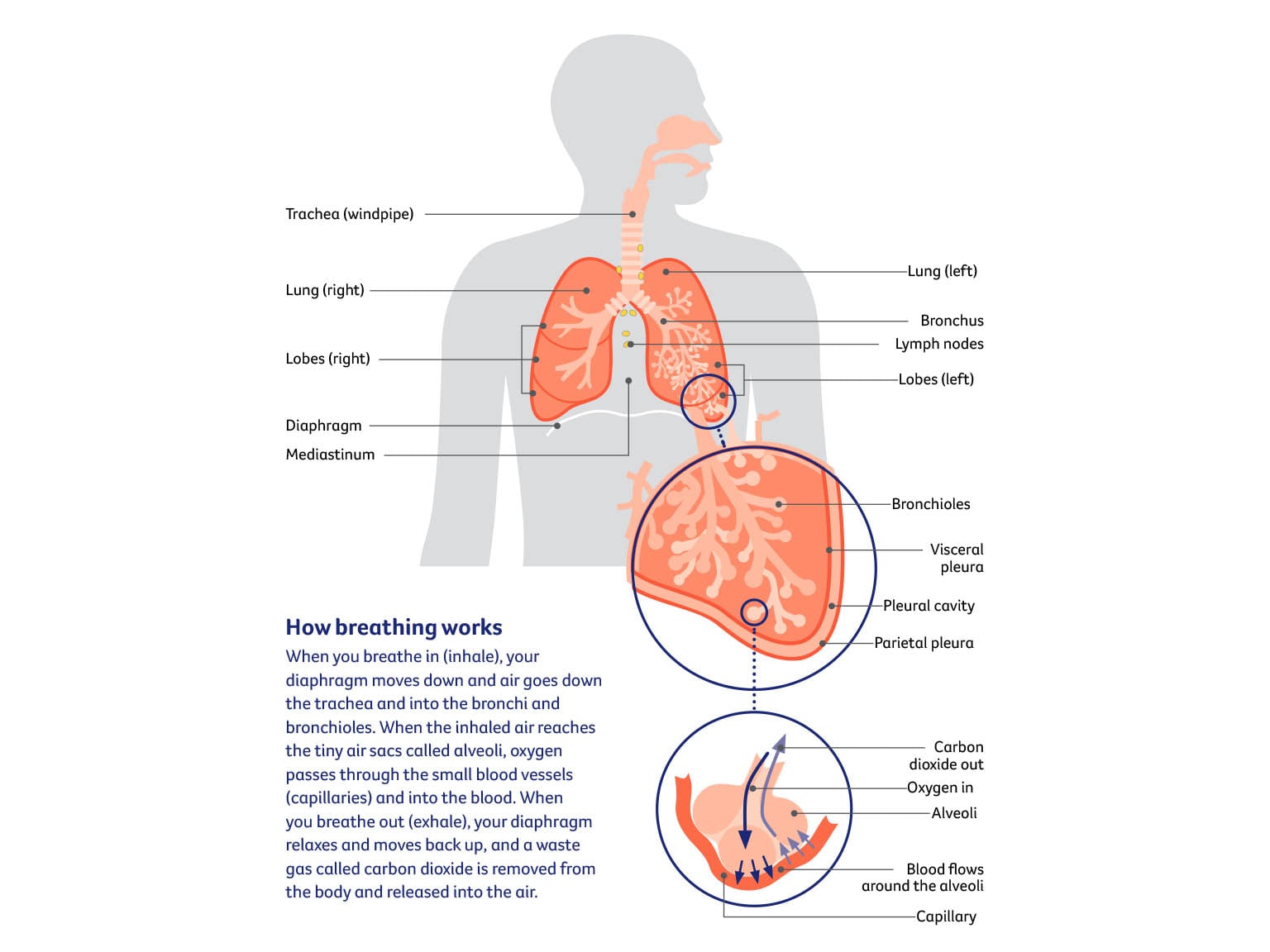
The lungs are 2 sponge-like organs that are used for breathing. They are part of the respiratory system, which also includes the nose, mouth, trachea (windpipe) and airways (tubes) to each lung. There are large airways known as bronchi (singular: bronchus) and small airways called bronchioles. The lungs sit in the chest and are protected by the rib cage.
Lobes – Each lung is made up of sections called lobes – the left lung has 2 lobes, and the right lung has 3 lobes.
Diaphragm – The lungs rest on the diaphragm, which is a wide, thin muscle that helps with breathing, and separates the chest from the abdomen (belly).
Mediastinum – The space between the lungs is called the mediastinum. A number of important structures lie in this space, including:
- the heart and large blood vessels
- the trachea – the tube that carries air into the lungs
- the oesophagus – the tube that carries food to the stomach
- lymph nodes – small, bean-shaped structures that collect and destroy bacteria and viruses.
Pleura – The lungs are covered by 2 thin layers of tissue called the pleura. The inner layer (visceral pleura) lines the lung surface, and the outer layer (parietal pleura) lines the chest wall, mediastinum and diaphragm. The layers are separated by a small amount of fluid that lets them smoothly slide over each other when you breathe. The pleural cavity is the potential space between the 2 layers; there is no space between the layers when the lungs are healthy.
The respiratory system
How common is lung cancer?
It is estimated that 15,108 people were diagnosed with lung cancer in 2025. The average age at diagnosis is 72 years old.
More men than women develop lung cancer, but since the early 1980s rates have been steadily decreasing among men and increasing among women.
Sources and references
This edition has been developed by Cancer Council NSW on behalf of all other state and territory Cancer Councils as part of a National Cancer Information Subcommittee initiative. We thank the reviewers of this booklet: Dr Malinda Itchins, Thoracic Medical Oncologist, Royal North Shore Hospital and Chris O’Brien Lifehouse, NSW; Dr Cynleen Kai, Radiation Oncologist, GenesisCare, VIC; Dr Naveed Alam, Thoracic Surgeon, St Vincent’s Hospital, Epworth Richmond, and Monash Medical Centre, VIC; Helen Benny, Consumer; Dr Rachael Dodd, Senior Research Fellow, The Daffodil Centre, NSW; Kim Greco, Specialist Lung Cancer Nurse Consultant, Flinders Medical Centre, SA; Caitriona Nienaber, 13 11 20 Consultant, Cancer Council WA; Marco Salvador, Consumer; Janene Shelton, Lung Foundation Australia – Specialist Lung Cancer Nurse, Darling Downs Health, QLD; Prof Emily Stone, Respiratory Physician, Department of Thoracic Medicine and Lung Transplantation, St Vincent’s Hospital Sydney, NSW; A/Prof Marianne Weber, Stream Lead, Lung Cancer Policy and Evaluation, The Daffodil Centre, NSW. We would also like to thank the health professionals, consumers and editorial teams who have worked on previous editions of this title.

Lung cancer
Cancer Council 13 11 20
Call us to talk to a specially trained health professional for free and confidential support and information.
Guide to best cancer care
This lung cancer guide explains the standard of high-quality cancer care that all Australians can expect, from diagnosis, to treatment, recovery, and living with cancer.