

Types of cancer
About melanoma
Melanoma is a type of skin cancer, and one of the most common types of cancer in Australia and New Zealand.


Last updated:
Sources and references 
What is melanoma?
Melanoma is a type of skin cancer. It develops in the skin cells called melanocytes. Melanoma most often develops in areas that have been exposed to the sun. It can also start in areas that don’t receive much sun, such as the eye (uveal or ocular melanoma); nasal passages, mouth and genitals (mucosal melanoma); and the soles of the feet or palms of the hands, and under the nails (acral melanoma).
Other types of skin cancer, called non-melanoma skin cancers or keratinocyte cancers, are basal cell carcinoma (BCC) and squamous cell carcinoma (SCC). These are far more common than melanoma. However, melanoma is considered more serious because it can spread to other parts of the body, especially if not found early.
The skin
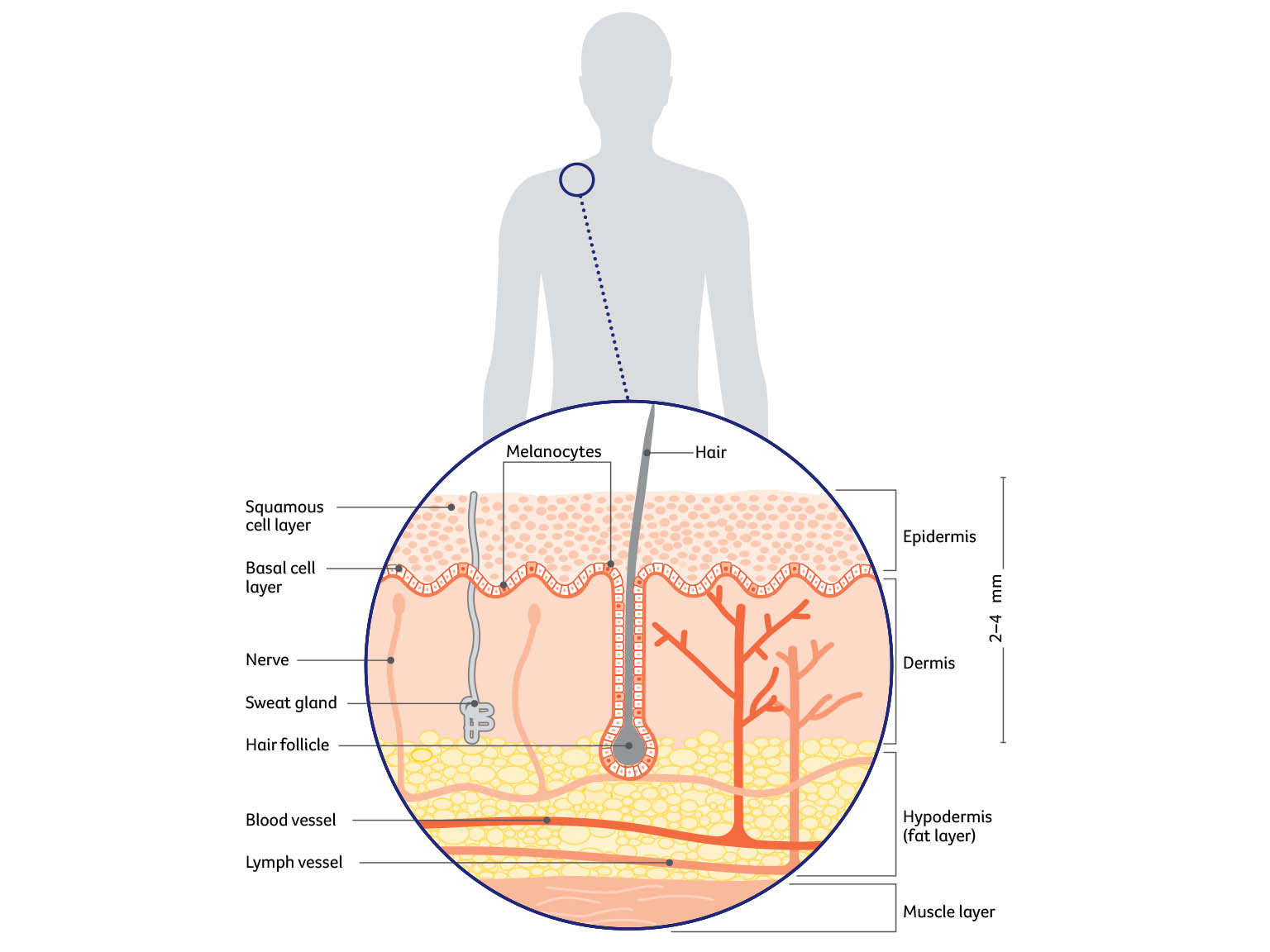
The skin is the largest organ of the body. It protects the body from injury, controls body temperature and prevents loss of body fluids. The 2 main layers of the skin are called the epidermis and the dermis. Below these is a layer of fatty tissue known as the hypodermis.
The layers of the skin
Epidermis
The epidermis is the top, outer layer of the skin. It is made up of several sublayers that work together to continually rebuild the surface of the skin. The main sublayers are the basal cell layer and the squamous cell layer.
Squamous cell layer – This sits above the basal cell layer. Basal cells that have matured move up into the squamous cell layer. Here they are known as squamous cells or keratinocyte cells. Squamous cells are the main type of cell found in the epidermis.
Basal cell layer – This is the lowest layer of the epidermis. It contains basal cells and cells called melanocytes. The melanocyte cells produce a dark pigment called melanin, which gives skin its colour. When skin is exposed to ultraviolet (UV) radiation, melanocytes make melanin to try to protect the skin from getting burnt. This is what causes skin to tan. When melanocytes cluster together, they form non-cancerous spots on the skin called moles or naevi.
Dermis
This layer of the skin sits below the epidermis. The dermis is made up of fibrous tissue and contains the roots of hairs (follicles), sweat glands, blood vessels, lymph vessels and nerves.
How common is melanoma?
Australia and New Zealand have the highest rates of melanoma in the world. Each year in Australia, almost 19,000 people are diagnosed with invasive melanoma (it has spread into the dermis, the lower layer of the skin)2 and 28,000 people are diagnosed with melanoma in situ (it is only in the epidermis, the top layer)3. In Australia, melanoma is the second most common cancer in men and the third most common in women (excluding non-melanoma skin cancers).
Does melanoma run in families?
Less than 2% of melanomas are linked to an inherited faulty gene. You could have an inherited faulty gene if 2 or more close relatives (parent, sibling or child) have been diagnosed with melanoma, particularly if they were diagnosed with more than one melanoma, or if they were diagnosed with melanoma before the age of 40.
People with a strong family history of melanoma should take extra care with sun protection and regularly check their skin carefully for new moles or skin spots. From their early 20s, they should consider having a professional skin check by a doctor.
If you are concerned about family risk, talk to your doctor about being referred to a family cancer clinic. Visit Centre for Genetics Education to find a family cancer clinic near you. To learn more, call Cancer Council 13 11 20.
What are the main types of melanoma?
Melanoma of the skin is known as cutaneous melanoma. The main subtypes of cutaneous melanoma are shown in the table below. Some rarer types of melanoma start in other parts of the body. Mucosal melanoma can start in the tissues in the mouth, anus, urethra, vagina or nasal passages. Ocular melanoma can start inside the eye. Melanoma can also start in the central nervous system.
Subtype – superficial spreading melanoma
Prevalence: 55-60% of melanomas
Who gets it: The most common type of melanoma in people under 40, but can occur at any age
What it looks like: Can start as a new brown or black spot that grows on the skin, or as an existing spot, freckle or mole that changes size, colour or shape
Where it is found: Can develop on any part of the body but especially in the area between the shoulders and hip (trunk)
How it grows: Often grows slowly and becomes more dangerous when it invades the lower layer of the skin (dermis).
Subtype – nodular melanoma
Prevalence: 10-15% of melanomas
Who gets it: Most commonly found in people over 65
What it looks like: Usually appears as a round, raised lump (nodule) on the skin that is pink, red, brown or black and feels firm to touch; may develop a crusty surface that bleeds easily
Where it is found: Usually found on sun-damaged skin
How it grows: Often a fast-growing form of melanoma, spreading quickly into the lower layer of the skin (dermis)
Subtype – lentigo maligna melanoma
Prevalence: 10-15% of melanomas
Who gets it: Most people with this subtype are over 40
What it looks like: Begins as a flat, irregular patch of discoloured skin which can be brown, pink, red or white
Where it is found: Mostly found on sun-damaged skin on the face, ears, neck or head
How it grows: May grow slowly and superficially over many years before it grows deeper into the skin
Subtype – acral lentiginous melanoma
Prevalence: 1-2% of melanomas
Who gets it: Mostly affects people over 40 with dark skin such as those of African, Asian and Hispanic backgrounds
What it looks like: Often appears as a colourless or lightly coloured area, may be mistaken for a stain, bruise or unusual wart; in the nails, can look like a long streak of pigment
Where it is found: Most commonly found on the palms of the hands, on the soles of the feet, or under the fingernails or toenails
How it grows: Tends to grow slowly until it invades the lower layer of the skin (dermis)
Subtype – desmoplastic melanoma
Prevalence: 1-2% of melanomas
Who gets it: Mostly affects people over 60
What it looks like: Starts as a firm, growing lump, often the same colour as your skin; may be mistaken for a scar and can be difficult to diagnose
Where it is found: Mostly found on sun-damaged skin on the head or neck, including the lips, nose and ears
How it grows: Tends to be slower to spread than other subtypes, but often diagnosed later; sometimes can spread via nerves
Sources and references
Understanding Melanoma - A guide for people with cancer, their families and friends
Acknowledgements
This edition has been developed by Cancer Council NSW on behalf of all other state and territory Cancer Councils as part of a National Cancer Information Subcommittee initiative.
We thank the reviewers of this booklet: A/Prof Rachel Roberts-Thomson, Medical Oncologist, The Queen Elizabeth Hospital, SA; A/Prof Robyn Saw, Surgical Oncologist, Melanoma Institute Australia, Royal Prince Alfred Hospital and The University of Sydney, NSW; Alison Button-Sloan, Consumer; Dr Marcus Cheng, Radiation Oncologist Registrar, Alfred Health, VIC; Prof Anne Cust, Deputy Director, The Daffodil Centre, The University of Sydney and Cancer Council NSW, Chair, National Skin Cancer Committee, Cancer Council, and faculty member, Melanoma Institute Australia; Prof David Gyorki, Surgical Oncologist, Peter MacCallum Cancer Centre, VIC; Dr Rhonda Harvey, Mohs Surgeon, Dermatologist, Green Square Dermatology, The Skin Hospital, Darlinghurst and Sydney Melanoma Diagnostic Centre, RPA, NSW; David Hoffman, Consumer; A/Prof Jeremy Hudson, Southern Cross University, James Cook University, Chair of Dermatology RACGP, Clinical Director, North Queensland Skin Cancer, QLD; Dr Damien Kee, Medical Oncologist, Austin Health and Peter MacCallum Cancer Centre and Clinical Research Fellow, Walter & Eliza Hall Institute, VIC; Angelica Miller, Melanoma Community Support Nurse, Melanoma Institute Australia, WA; Romy Pham, 13 11 20 Consultant, QLD; A/Prof Sasha Senthi, Radiation Oncologist, Alfred Health, and Clinical Research Fellow, Victorian Cancer Agency, VIC; Dr Chistoph Sinz, Dermatologist, Melanoma Institute Australia, NSW; Dr Amelia Smit, Research Fellow, Melanoma and Skin Cancer, The Daffodil Centre, The University of Sydney and Cancer Council NSW; Nicole Taylor, Clinical Nurse Consultant, Crown Princess Mary Cancer Centre, Westmead Hospital, NSW.
We also thank the health professionals, consumers and editorial teams who have worked on previous editions of this site.
References
- Cancer Council Australia Melanoma Guidelines Working Party, Clinical practice guidelines for the diagnosis and management of melanoma, Melanoma Institute Australia, Sydney, viewed 31 January 2025, available from cancer.org.au/clinical-guidelines/skin-cancer/melanoma.
- Australian Institute of Health and Welfare (AIHW), Cancer Data in Australia, AIHW, Canberra,
2024, viewed 31 January 2025, available from aihw.gov.au/reports/cancer/cancer-data-inaustralia/data. - Australian Institute of Health and Welfare (AIHW), Cancer in Australia 2021, AIHW, Canberra, 2021.
Melanoma
Cancer Council 13 11 20
Call us to talk to a specially trained health professional for free and confidential support and information.
Guide to best cancer care
This melanoma guide explains the standard of high-quality cancer care that all Australians can expect, from diagnosis, to treatment, recovery, and living with cancer.